About 90 people a month search "website vs landing page" in the US, and another 1,600 search "landing page design" (our September 2026 pull). The question usually shows up at the same moment: you are about to spend money on ads, and you are not sure whether to send the clicks to your homepage or build something new. Here is the short version, the cases where each one wins, and what both cost.
What is the difference between a website and a landing page?
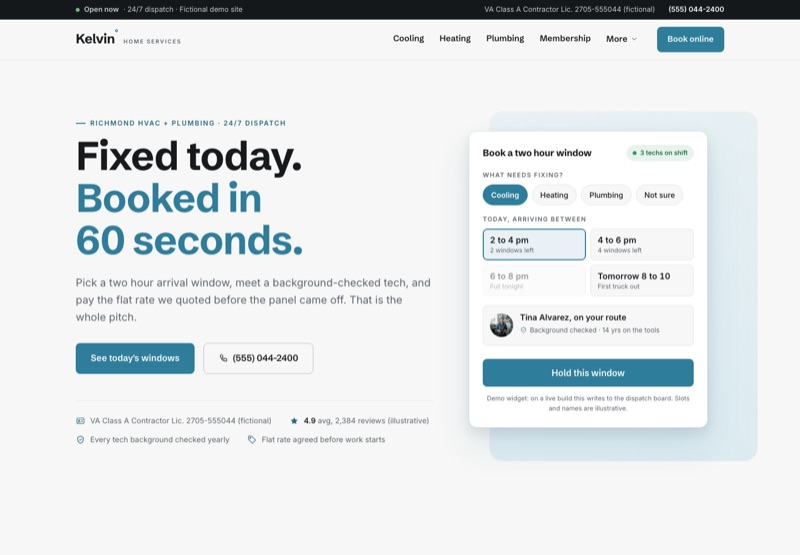
A website is a set of connected pages with navigation, built so anyone can find anything: services, pricing, about, contact, reviews, locations. A landing page is a single page with one offer, one message and one action, and the navigation is deliberately stripped out so the visitor has nothing to do except convert or leave.
The difference is intent. Someone on your website is researching and may have arrived from a Google search, a referral or a business card.
Someone on a landing page arrived from a specific ad about a specific thing, and every extra link on that page is a chance to wander off before they call.
When do you need a website?
You need a website if people look you up before they call, which is nearly every local business. A website is what earns organic search traffic, what your Google Business Profile links to, what a referred customer checks before dialling, and what carries the pages that rank: each service, each location, your reviews and your contact details.
- You want to be found in search. Landing pages built for ads rarely rank. Ranking takes many pages that answer many questions, which is a website's job.
- You sell more than one thing. A roofer selling repair, replacement and gutters needs a page per service, because the person searching "roof repair" and the person searching "roof replacement" want different proof.
- Referrals check you out first. A referral who cannot find a real site treats that as a reason to keep calling around.
- You have more than one location. Each location needs its own page with its own address, hours and directions.
- You want an asset that keeps working. A website keeps producing after you pause the ads. A campaign stops the day the budget does.
When do you need a landing page?
You need a landing page whenever you are paying for traffic to one offer. If you are running Google Ads, Facebook and Instagram ads, a direct mail QR code or a seasonal promotion, the click should arrive somewhere that repeats the exact promise of the ad and asks for one thing.
A page built for one offer routinely out-converts a homepage at the same ad spend, which is why every campaign Ziwi runs gets its own tracked page as part of the build.
- 01
One offer, one action. A free estimate, an implant consultation, a maintenance plan sign-up. Not all three on one page.
- 02
The ad's exact words appear on the page. If the ad says "same-day AC repair" and the page says "welcome to our website", the visitor decides they clicked the wrong thing.
- 03
No navigation, no distractions. Remove the menu, the blog link and the careers page for the length of the campaign.
- 04
Tracked end to end. Calls and form fills from that page are counted separately, so you can see what the campaign actually booked rather than what it clicked.
- 05
Fast on a phone. Most local ad traffic is mobile, and a slow page loses people before the headline finishes loading.
How do a website and a landing page compare side by side?
The two are built to different rules. This is the practical comparison for a local service business.
| What decides it | Website | Landing page |
|---|---|---|
| Job to be done | Be found, answer every question, look legitimate | Convert one specific offer into a call or form |
| Pages | Typically 5 to 20 and growing | One |
| Navigation | Full menu, footer, internal links | Stripped out on purpose |
| Main traffic source | Organic search, Google Business Profile, referrals | Paid ads, email, direct mail, QR codes |
| Measured by | Calls, forms, rankings and traffic over months | Cost per booked lead for one campaign |
| Lifespan | Years, updated continuously | As long as the campaign runs |
| Built by Ziwi as part of | Websites and landing pages | Landing page design services and every ads plan |
Not sure which one you need?
Can a landing page replace your website?
Only for a brand-new business testing an offer for a few weeks, and even then it is a stopgap. A single landing page cannot rank for the range of searches a local business needs, cannot hold a page per service or per location, and gives a curious customer nowhere to confirm you are real. As soon as the offer works, the page becomes one entry point into a proper site.
The reverse mistake is more expensive: sending paid clicks to a homepage. The homepage was written for everyone, so it opens with your name rather than the offer the visitor just clicked, and it offers a menu of ways to leave. You paid for that click either way. See how the page and the campaign work together on Google Ads management.
What do a website and a landing page cost at Ziwi?
Every price is published, as of September 2026. A website is $0, $1,000 or $2,500 depending on the build, and an extra page is $149 one time. Campaign landing pages are built inside the ads plans, so a business already running ads with Ziwi does not pay separately for them.
| What you are building | Price | What it includes |
|---|---|---|
| Website with an ongoing plan | $0 build fee | The website build, waived when you keep a plan 12 months. Live in 3 days from kickoff |
| Designed template website | $1,000 one time | A designed template made yours, written for your business, live in 3 days |
| Custom website design | $2,500 one time | Custom design and build, same 3-day standard from kickoff |
| Extra page on an existing site | $149 one time | One more page, including a standalone landing page |
| Campaign landing page | Included in ads management | Ads management is $297 a month with ad spend up to $1,500, $497 with $1,500 to $3,500 in spend, $797 above $3,500. Ad spend is paid to the platform on top |
| Keeping it online after launch | $99 or $299 a month | Hosting at $99, or Ziwi Care at $299 per location with weekly content and unlimited small edits, first month free |
Which should you build first?
Build the website first if you are not spending on ads yet, and build the landing page first if the ads are already running and pointed at a homepage. The second case is the more urgent one, because you are paying for traffic today and losing it on arrival. If both are true, they get built together: the site as home base, one page per offer on top of it.
- 01
Name the one action. A booked call, a quote request, a scheduled estimate. Everything else on the page serves it.
- 02
Count your services and locations. More than one of either, and you need a site, not a page.
- 03
Check whether you are paying for clicks. If yes, a dedicated page is the cheapest improvement available to you.
- 04
Decide the timeline. Ziwi's standard is live in 3 days from kickoff. Our guide on how long it takes to build a website covers what actually sets that clock.
- 05
Wire the tracking before launch. Calls and forms tagged by source, or you will be guessing which page did the work.
Most local businesses end up with one site and one page per campaign, and that combination is what Ziwi builds and prices on the websites and landing pages service page. If you only need the campaign half, the detail lives on landing page design services, and every published number is on pricing.